
Stackable or Stranded? Which Micro-Credentials Become Qualifications
What the evidence says about credit, completion and earnings, and a five-part test for which ones to back
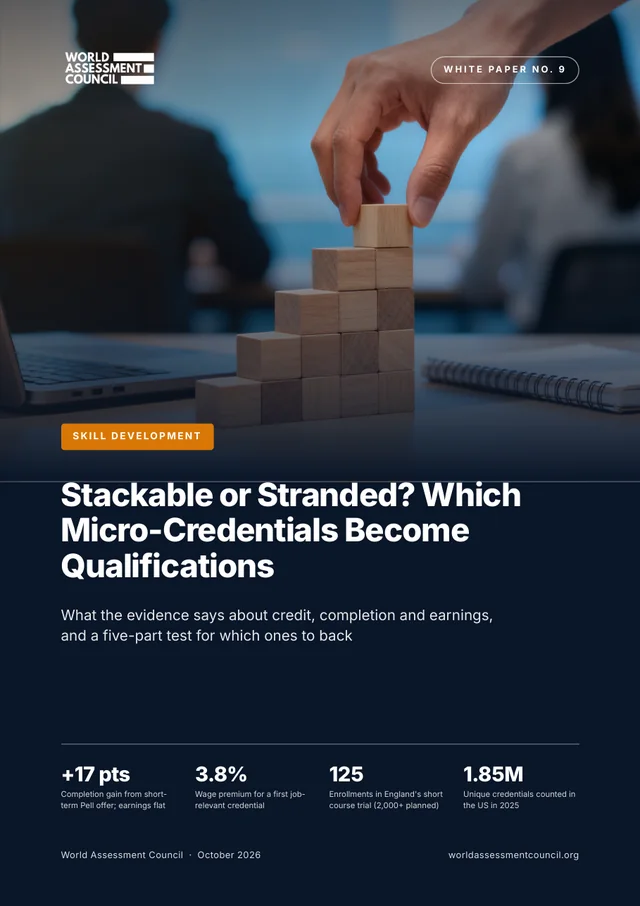
Micro-credentials are now built into funding and credit rules in the US, England, the EU, India and Australia. This paper reviews the evidence on when short credentials stack into recognized qualifications and pay off. Progressive, job-relevant stacks tend to pay; stand-alone short awards often do not, and funding raises completion more reliably than earnings. It ends with the STACK Test for institutions.
Key findings
- Offering Pell Grants for short occupational programs raised completion by 17 percentage points in the larger of two randomized experiments but produced no measurable gain in employment or earnings an average of 3.2 years after expected completion.
- In Ohio health care programs, learners who began with a short-term certificate and stacked upward to a higher credential saw earnings gains of about 36 percent, against roughly zero for those who stopped at the certificate; these are associations, not causal effects.
- Across 37.7 million US resumes, a first job-relevant non-degree credential was associated with a 3.8 percent wage premium, and only relevant credentials added value as they accumulated.
- Stacking a second community college credential raised working adults' quarterly wages by $375, about 4 percent, in a Virginia fixed-effects study.
The paper has 2 more findings, the full evidence review and the framework.
A chart from the paper
Short-term Pell offer: effects on enrollment and completion
Percentage points
What is inside
- Executive summary and key findings
- Why this matters now
- Four systems, four meanings of "stackable"
- What the evidence shows
- Where the evidence is weak or contested
- A practical framework: the STACK Test
- Case snapshots
- What to measure
- Risks and open questions
- Recommendations for universities, educators, edtech leaders and policymakers
- Methodology, limits and 28 references
One recommendation for each audience
For university leaders
Run every short credential you issue through the STACK Test and publish which ones carry credit toward a named qualification.
For educators
Design assessments that verify performance with identity checks, not completion badges for viewing content.
For edtech leaders
Issue credentials carrying the EU's mandatory elements, including workload, level, assessment type and quality assurance.
For policymakers
Tie public funding for short programs to progression and earnings evidence, while monitoring whether outcome floors push providers away from disadvantaged learners.
This is a desk-research synthesis, not original fieldwork. We reviewed national policy texts and regulator reports from the EU, England, India, Australia and the United States, peer-reviewed and working-paper studies of credential returns, a randomized federal evaluation, OECD reviews, and quality journalism on 2026 implementation. Sources were chosen for rigor, recency and relevance to stacking and credit. Each source was opened and read. Institutional and company figures are labeled as such. The STACK Test is the authors' own framework. The cover picture is an AI-generated illustration. Send a correction · Research Standards
More white papers
Beyond the Transcript: When Can a Portfolio Be Trusted?
The Proof-of-Skill Gap: Why Skills-First Hiring Stalled

Global Without Leaving? What Virtual Exchange Can and Cannot Replace
From the same centre
See what the Centre for Skill Development works on, with its analysis and the news in its field.