
What Is a Degree Worth in Another Country?
Recognition, equivalence and the graduate premium abroad, and a five-layer test of whether a degree travels
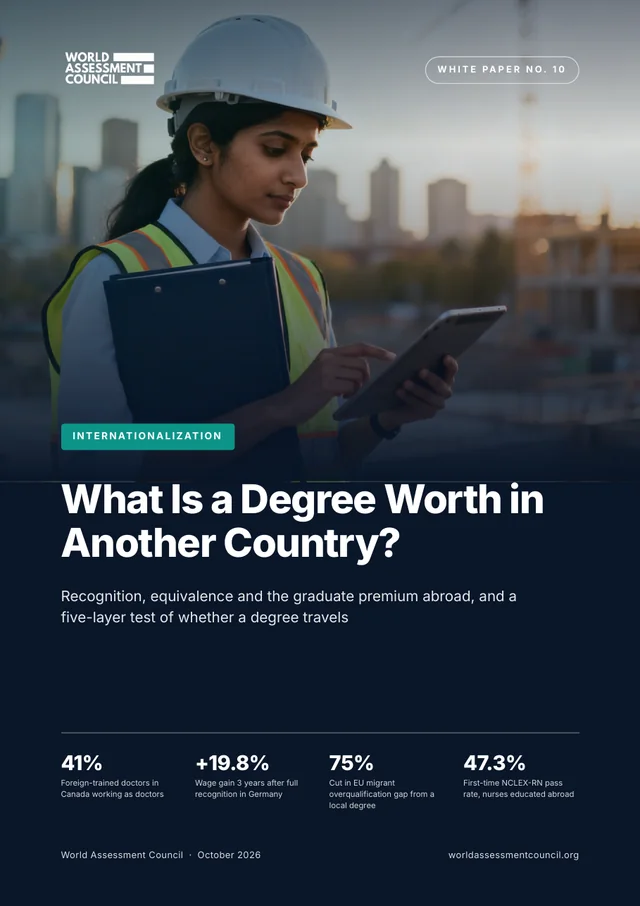
A degree's value changes when its holder moves country. This paper reviews recognition law, professional licensing, credential evaluation and fraud, the labor-market discount for foreign degrees and the returns earned by graduates who go home. It finds that recognition bodies, regulators and employers, rather than the diploma alone, set much of the discount, though part of it reflects real differences in skills and language, and it offers the LEVER Test for judging whether a program will hold its value abroad.
Key findings
- In Canada's 2021 Census, 25.8 percent of immigrants with a foreign degree were overqualified for their jobs, more than double the 11.8 percent for immigrants with a Canadian degree.
- Only 41.1 percent of immigrants in Canada with a foreign medical degree worked as doctors, compared with 90.1 percent of those with a Canadian medical degree.
- Full occupational recognition in Germany raised immigrants' employment rates by 24.5 percentage points and hourly wages by 19.8 percent after three years.
- In 2025, 47.3 percent of first-time internationally educated NCLEX-RN candidates passed, against 86.7 percent of first-time US-educated candidates.
The paper has 2 more findings, the full evidence review and the framework.
A chart from the paper
Canada: degree holders overqualified, by where they studied (2021)
Percent
What is inside
- Executive summary and key findings
- Why this matters now
- What the evidence shows
- Where the evidence is weak or contested
- A practical framework: the LEVER Test
- Case snapshots
- What to measure
- Risks and open questions
- Recommendations for universities, educators, edtech leaders and policymakers
- Methodology, limits and 34 references
One recommendation for each audience
For university leaders
Apply the LEVER Test to each professional program for the three to five countries where most graduates go, and publish the results to applicants before they enroll.
For educators
Build language and professional-communication skills into programs, since literacy and language explain much of the foreign-degree discount.
For edtech leaders
Build interoperable verification at the source rather than closed credential wallets, and publish verification times.
For policymakers
Ratify and implement the UNESCO Global Convention, and set deadlines in law for recognition decisions and appeals, as India's 2025 regulations do.
This is a desk-research synthesis, not original fieldwork. We searched for recognition treaties and their official texts, regulator and statistical agency reports (Canada, the United States, Germany, Australia, India), peer-reviewed and working papers on immigrant and returnee labor-market outcomes, and quality journalism on recent policy changes. We favored primary and causal or quasi-experimental studies and flagged descriptive, advocacy and company sources as such. Every figure comes from a page opened during research. The paper does not evaluate individual credential agencies or advise on specific immigration cases. The cover picture is an AI-generated illustration. Send a correction · Research Standards
More white papers
Global Without Leaving? What Virtual Exchange Can and Cannot Replace
The New Map of International Education After the Big Four Tightened
Stackable or Stranded? Which Micro-Credentials Become Qualifications
From the same centre
See what the Centre for Internationalization works on, with its analysis and the news in its field.