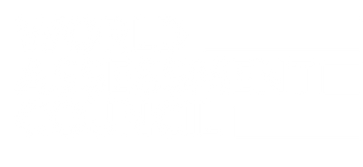
The Proof-of-Skill Gap: Why Skills-First Hiring Stalled
What employers trust, which credentials pay, and how to make a skill claim count as AI reshapes junior work
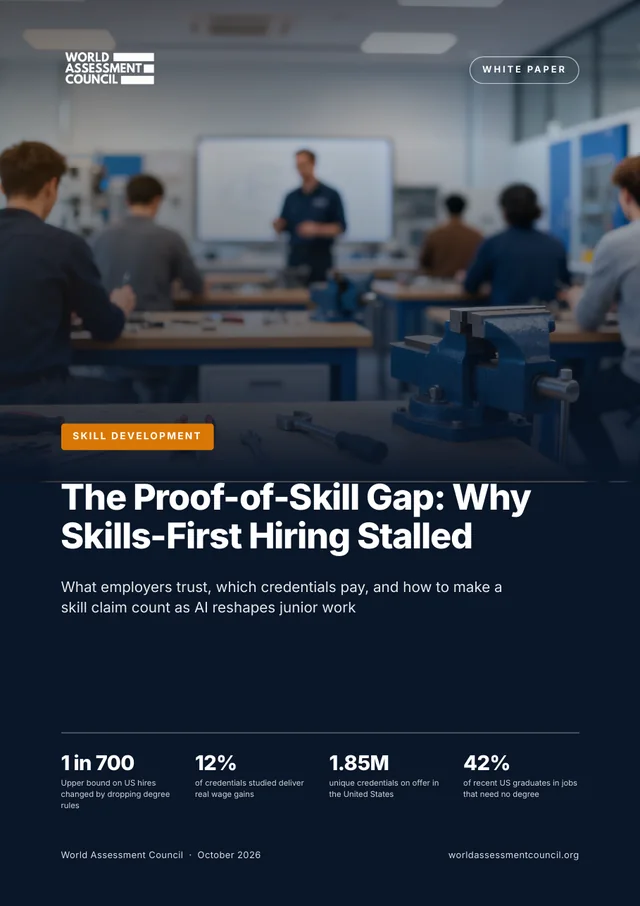
Employers say they hire for skills, yet hiring records show that dropping degree requirements changed fewer than 1 in 700 US hires. This white paper reviews the evidence on skills-based hiring, non-degree credentials and AI's effect on entry-level work, and sets out the Proof-of-Skill Ladder, a practical way for universities, platforms, employers and policymakers to judge whether a skill claim is strong enough to hire on.
Key findings
- Removing degree requirements from about 11,300 roles at large US firms raised the non-graduate share of hires by 3.5 percentage points, a net effect of roughly 97,000 workers a year, or fewer than 1 in 700 hires.
- Only 37 percent of firms that dropped degree requirements went on to hire materially more non-graduates, while 45 percent changed the posting and little else.
- Of 23,444 credentials analyzed against career histories, about 12 percent delivered significant wage gains that earners would not otherwise have had.
- Randomized evaluations of sector-focused training programs that combine screening, skills training and support services found earnings gains of 14 to 39 percent in the year or so after training.
The paper has 2 more findings, the full evidence review and the framework.
A chart from the paper
What large US firms did after dropping degree requirements
Share of firms studied (% of firms)
What is inside
- Executive summary and key findings
- Why this matters now
- What the evidence shows
- Where the evidence is weak or contested
- A practical framework: the Proof-of-Skill Ladder
- Case snapshots
- What to measure
- Risks and open questions
- Recommendations for universities, educators, edtech leaders and policymakers
- Methodology, limits and 32 references
One recommendation for each audience
For university leaders
Classify every award, module and micro-credential by rung of the Proof-of-Skill Ladder, and set a target for the share assessed independently (rung 4) or through observed work (rung 5).
For educators
Assess individuals inside team and challenge-based work, for example through an observed task or oral defense, because group deliverables hide individual learning.
For edtech leaders
Separate completion badges from assessed credentials in product design and naming, and state the rung on the credential itself.
For policymakers
Tie public funding for short credentials to outcomes, and fund the data systems that make the test fair: occupation in wage records, matching across jurisdictions and adjustment for regional wages.
This paper is desk research. We started from recent reporting and research on skills-based hiring, credentials and graduate jobs, then widened the search to peer-reviewed papers, working papers, official statistics, regulations and technical standards available by early October 2026, with journalism used for recent events. We favored studies that observe hires, earnings or randomized outcomes over surveys of intentions, and we report each study's design, sample and limits. Every source cited was opened and read. The paper reports no original survey, trial, interview program or dataset, and calculations of our own are labeled as such. The cover picture is an AI-generated illustration. Send a correction
More white papers
The New Map of International Education After the Big Four Tightened
What Can a Grade Still Prove? Rebuilding Trust in Assessment After AI
AI That Teaches: When Generative AI Builds Learning That Lasts
From the same centre
See what the Centre for Skill Development works on, with its analysis and the news in its field.