
From Recording to Course: AI Video Editing for University Lectures
What the evidence says about lecture video, and how to choose among platforms, editors, avatars and pipelines
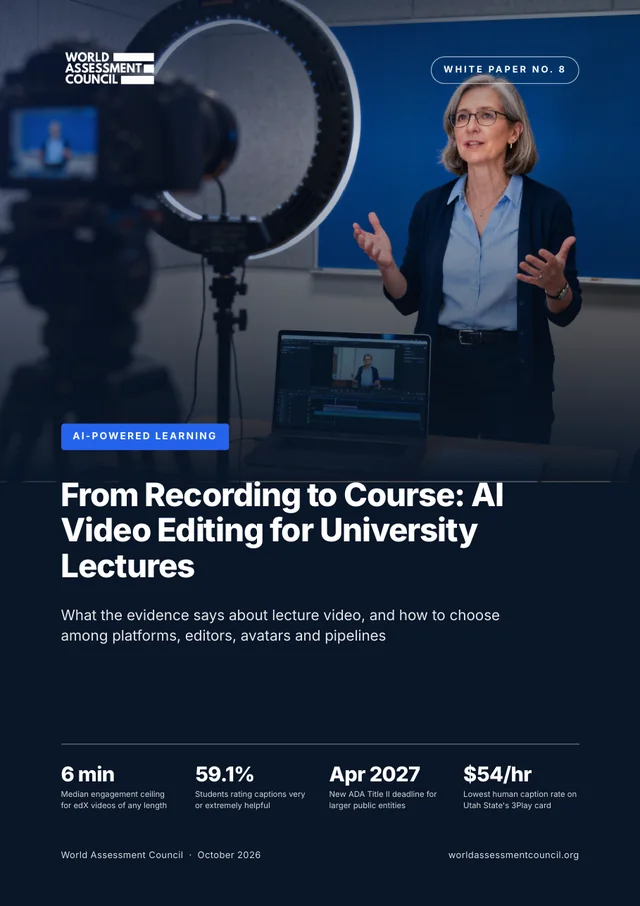
Universities hold large archives of recorded lectures but few finished, accessible lessons. This paper reviews evidence on which production choices matter for students, from length and segmentation to audio, captions and AI-generated presenters, and sets out the legal and faculty risks. It describes four approaches through four named providers and offers a decision table and a five-part production standard for choosing among them.
Key findings
- Across 6.9 million edX viewing sessions, median engagement was at most 6 minutes regardless of video length, and the share of sessions followed by a problem attempt fell from 56 percent for 0-3 minute videos to 31 percent for 12-40 minute videos.
- In one comparison of two edX courses, lectures planned for online video outperformed spliced-up classroom recordings, with 55 percent versus 41 percent of sessions followed by a problem attempt.
- In a survey of 2,124 students, 59.1 percent rated captions very or extremely helpful, although only 19.1 percent reported any difficulty hearing.
- In an online experiment with 447 crowd-sourced participants, human-made teaching videos gave a small advantage in learning experience over AI-generated ones, but exam results were similar.
The paper has 2 more findings, the full evidence review and the framework.
A chart from the paper
Shorter videos, more practice: problem attempts by video length
Sessions followed by a problem attempt
What is inside
- Executive summary and key findings
- Why this matters now
- What the evidence shows
- Where the evidence is weak or contested
- Four approaches, four providers
- A practical framework: the Recording-to-Course Decision Table
- Case snapshots
- What to measure
- Risks and open questions
- Recommendations for universities, educators, edtech leaders and policymakers
- Methodology, limits and 34 references
One recommendation for each audience
For university leaders
Inventory recordings by type and purpose, then use the Recording-to-Course Decision Table to assign each set to platform tools, an editor, an avatar tool or a post-production service.
For educators
Plan new lectures as short segments built around single ideas rather than relying on later cuts of a long recording.
For edtech leaders
Publish clearly what each feature does today and what is still on the roadmap.
For policymakers
Pair accessibility deadlines with guidance on acceptable caption accuracy for technical and STEM content.
This is a desk review of published research, regulation, institutional pages, vendor pages and news coverage opened between 2025 and October 2026. Studies were chosen for relevance to recorded higher education teaching, with priority for randomized trials, large datasets and systematic reviews. The four providers were chosen to illustrate four approaches; they are not ranked, and other providers offer similar tools. Provider descriptions rely on each vendor's public pages and are labeled as vendor claims. The paper reports no original data. The cover picture is an AI-generated illustration. Send a correction · Research Standards
More white papers

Buying AI for Education: A Standard for Evidence, Privacy and Cost
AI That Teaches: When Generative AI Builds Learning That Lasts

Beyond the Transcript: When Can a Portfolio Be Trusted?
From the same centre
See what the Centre for AI-Powered Learning works on, with its analysis and the news in its field.