
Beyond the Transcript: When Can a Portfolio Be Trusted?
What employers use, what raters can agree on, and when records of real work deserve weight
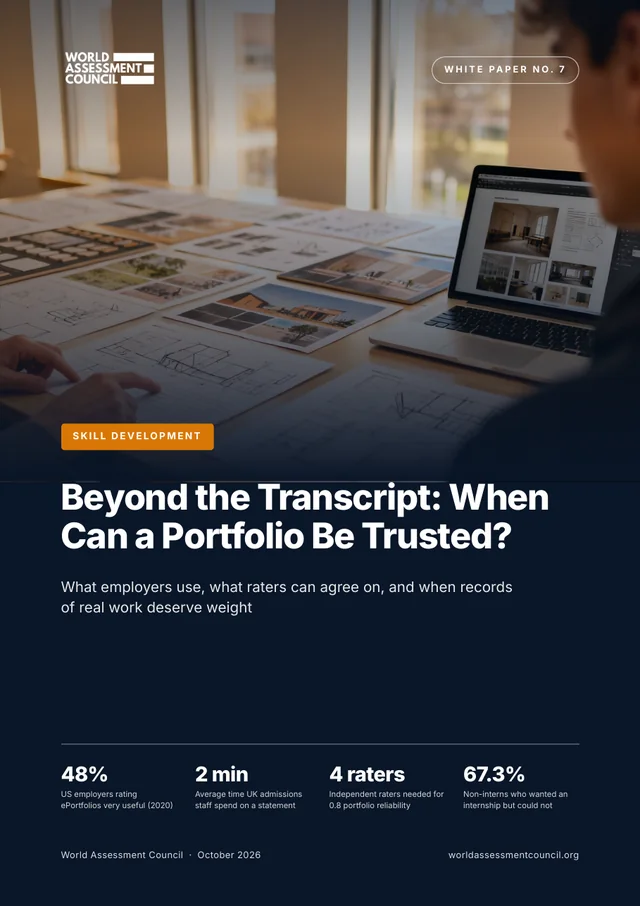
As grades compress and AI weakens unsupervised written work as evidence, universities are building portfolios and comprehensive learner records to sit beside the transcript. This paper reviews evidence on employer use, scoring reliability, cost, authorship and equitable access. It finds strong stated interest, thin actual use and reliability that depends on design. It proposes the TRACE Ladder for deciding when a record of demonstrated work can be trusted.
Key findings
- Employers' stated preference has shifted: 48% of US employers rated ePortfolios very useful in 2020, against 38% for transcripts, up from 36% and 9% in 2015.
- Actual use lags interest: in a 2008 survey sent to 5,310 employers (13% responded), only 16% of ePortfolio users consulted them at initial screening and fewer than 1% after the first interview.
- Reading time is scarce: UK admissions staff spend an average of two minutes on a personal statement, and 39% get one minute or less.
- Portfolio scoring can be unreliable at scale: Vermont's 1992 writing portfolios showed rater agreement of only 0.28 to 0.57.
The paper has 2 more findings, the full evidence review and the framework.
A chart from the paper
Employers rating ePortfolios vs transcripts very useful
Percent
What is inside
- Executive summary and key findings
- Why this matters now
- What the evidence shows
- Where the evidence is weak or contested
- A practical framework: the TRACE Ladder
- Case snapshots
- What to measure
- Risks and open questions
- Recommendations for universities, educators, edtech leaders and policymakers
- Methodology, limits and 32 references
One recommendation for each audience
For university leaders
Classify every record you issue on the TRACE Ladder, and stop presenting unverified showcase portfolios to employers as evidence.
For educators
Double-score a sample of portfolio work every term and report agreement, using shared global rubrics and calibration discussions.
For edtech leaders
Ship verification by default: signed records, visible provenance and a one-screen summary with drill-down evidence.
For policymakers
Fund independent field experiments on whether verified learner records change hiring and admission outcomes, especially for first-generation students.
This is a desk-research synthesis, not original fieldwork. We searched journal databases, regulator and association reports, and news coverage from 1992 to October 2026, prioritizing peer-reviewed studies, official statistics and evaluations with stated samples. Every figure was checked against the source page. Employer surveys are reported as stated preferences, and consortium or vendor statements as claims. The paper does not evaluate specific products, and it leaves the design of authentic tasks and cross-border credential wallets to later papers in the series. The cover picture is an AI-generated illustration. Send a correction · Research Standards
More white papers
The Proof-of-Skill Gap: Why Skills-First Hiring Stalled
From Recording to Course: AI Video Editing for University Lectures
Buying AI for Education: A Standard for Evidence, Privacy and Cost
From the same centre
See what the Centre for Skill Development works on, with its analysis and the news in its field.