
The Rise of the Regional Hub: Asia, the Gulf and the New Student Flows
What Japan, Korea, the Gulf, Malaysia and India's new campuses reveal about which education hubs will hold
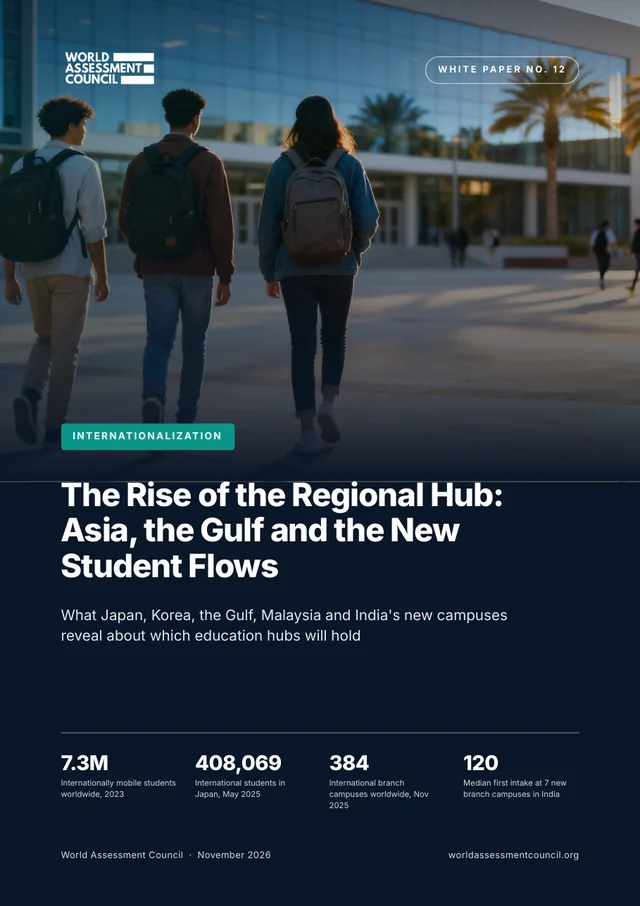
Visa limits in the traditional destinations have pushed students toward regional hubs. This paper reviews the evidence on Japan, South Korea, China, Hong Kong, Malaysia, Singapore, the UAE, Qatar, Saudi Arabia and India: who is enrolling, what hub strategies have delivered, where they failed, and how war and politics tested them in 2026. It offers the ANCHOR Test for judging whether a hub will hold.
Key findings
- Japan's international student count rose from 231,146 in 2022 to 408,069 in 2025, passing a 2033 target of 400,000 early, but 140,174 of those students were in language institutes.
- South Korea reached about 314,400 international students by February 2026, with Vietnam supplying 115,140 and roughly 75,500 enrolled in Korean-language study rather than at higher education institutions.
- UNESCO data show the UAE's inbound student count rising from 54,162 in 2012 to 237,034 in 2023, while 65 percent of Qatar's and 57 percent of Saudi Arabia's inbound students come from other Arab States.
- C-BERT counted 384 international branch campuses in November 2025, with China including Hong Kong hosting 50 and the UAE 39.
The paper has 2 more findings, the full evidence review and the framework.
A chart from the paper
International students in Japan, 2019-2025 (as of May 1)
Students
What is inside
- Executive summary and key findings
- Why this matters now
- What the evidence shows
- Where the evidence is weak or contested
- A practical framework: the ANCHOR Test
- Case snapshots
- What to measure
- Risks and open questions
- Recommendations for universities, educators, edtech leaders and policymakers
- Methodology, limits and 35 references
One recommendation for each audience
For university leaders
Apply the ANCHOR Test before any hub campus or major partnership, and treat three red flags as a reason to choose a lighter model such as a joint program.
For educators
Plan for wide differences in language readiness among hub entrants, using diagnostic checks and language support from the first term.
For edtech leaders
Help regulators and institutions publish comparable hub data that separates degree students from language and short-course students.
For policymakers
Publish enrollment statistics by level and program type, and align national counts with UNESCO definitions.
This paper is a desk-research synthesis. Sources were chosen for authority and recency: UNESCO's 2026 global trends report, national statistics and regulator releases from Japan, Dubai, Hong Kong and India, C-BERT branch campus data, peer-reviewed and practitioner research on education hubs, and quality journalism for 2025-2026 events. Figures were taken from pages opened during the research and checked for definition differences. The paper does not present original surveys, interviews or data, and it does not rank individual hubs. The cover picture is an AI-generated illustration. Send a correction · Research Standards
More white papers
Global Without Leaving? What Virtual Exchange Can and Cannot Replace
What Is a Degree Worth in Another Country?
The New Map of International Education After the Big Four Tightened
From the same centre
See what the Centre for Internationalization works on, with its analysis and the news in its field.