
Assessing What AI Cannot Do: Authentic Tasks and Live Performance
Which tasks still need the student's own performance, how reliable they are, and what they cost
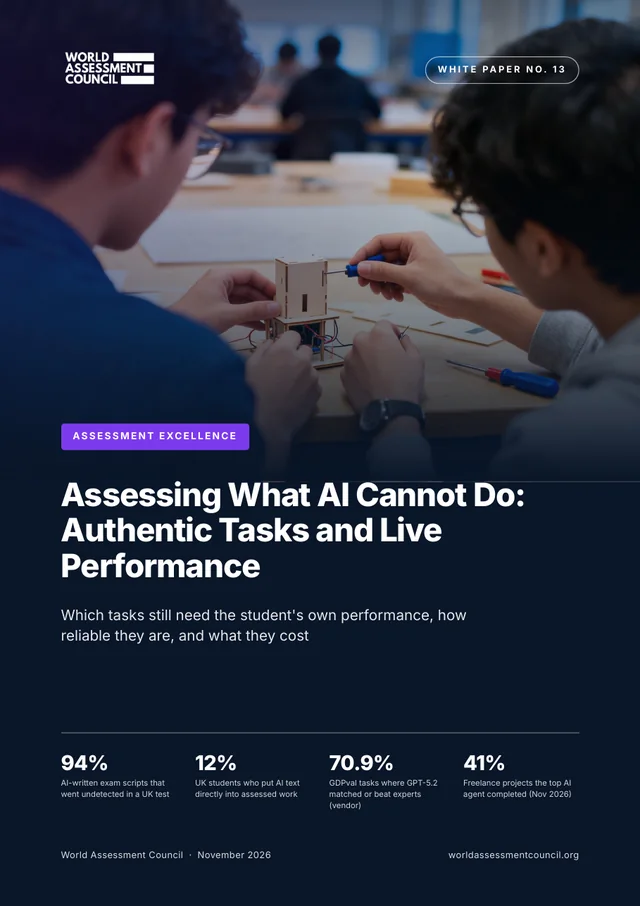
AI now writes passable answers to many authentic tasks, and markers rarely notice. This paper reviews the 2023 to 2026 evidence on what AI can and cannot do in real work, on whether authentic assessment resists it, and on the reliability and cost of live performance assessment. It proposes the HUMAN Check, a five-property test for deciding which tasks verify a student's own capability.
Key findings
- In a blind test at a UK university, 94 percent of 63 AI-written exam scripts went undetected, and the AI scripts had an 83.4 percent chance of outscoring a random set of the same number of real students.
- In 2026, 94 percent of 1,054 UK undergraduates used AI for assessed work, and 12 percent put AI text directly into it, up from 3 percent in 2024.
- In experiments with eight markers, pairs identified AI-involved work correctly only 33.3 to 85.7 percent of the time, and task authenticity did not help.
- On the Remote Labor Index, the best AI agent completed 2.5 percent of 240 real freelance projects in October 2025 and the top agent completed 41.25 percent on the November 2026 leaderboard [14, 15].
The paper has 2 more findings, the full evidence review and the framework.
A chart from the paper
Share of AI-written exam scripts flagged by markers, by module
AI scripts flagged for any concern
What is inside
- Executive summary and key findings
- Why this matters now
- What the evidence shows
- Where the evidence is weak or contested
- A practical framework: the HUMAN Check
- Case snapshots
- What to measure
- Risks and open questions
- Recommendations for universities, educators, edtech leaders and policymakers
- Methodology, limits and 31 references
One recommendation for each audience
For university leaders
Map every certified program capability and confirm that at least one Here-and-now, Unscripted or Material assessment verifies it before graduation.
For educators
Add unscripted follow-up questions to presentations and projects so the live element tests understanding, not delivery.
For edtech leaders
Build tools that cut the cost of live assessment, such as scheduling, station rotation and rater calibration, rather than detection.
For policymakers
Ask institutions to show how each award's core capabilities are verified securely, rather than requiring security in every unit.
This paper is a desk-research synthesis, not original fieldwork. Sources were chosen for direct relevance to assessing performance that AI cannot substitute, with priority to peer-reviewed studies, regulator and exam-board documents, and benchmark papers from 2023 to 2026, plus quality journalism for recent events. Each source was opened and read. Benchmark and vendor figures are labeled as such. Calculations of our own are marked. The paper does not evaluate any product, and does not cover proctoring or accommodation in depth; later papers in the series do. The cover picture is an AI-generated illustration. Send a correction · Research Standards
More white papers
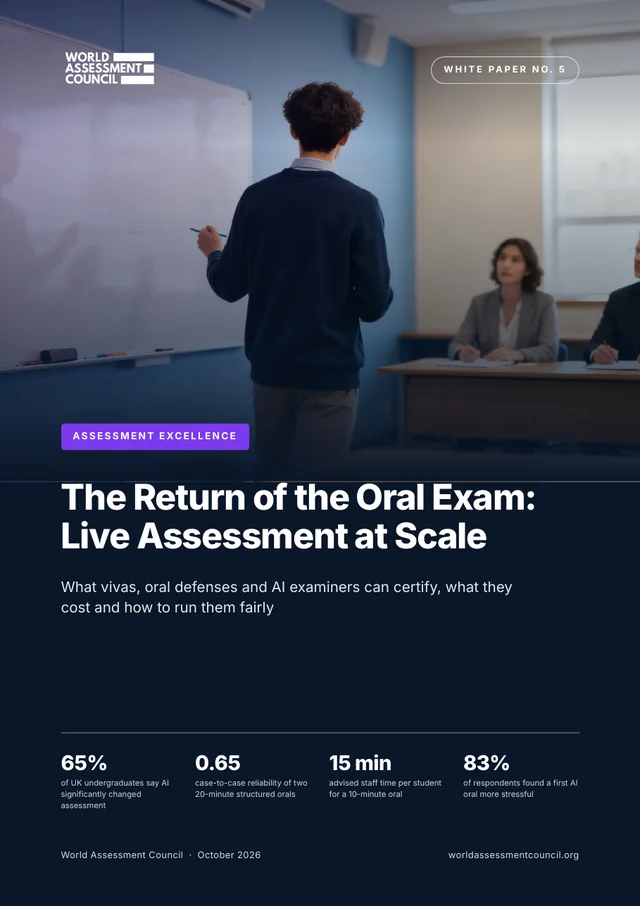
The Return of the Oral Exam: Live Assessment at Scale
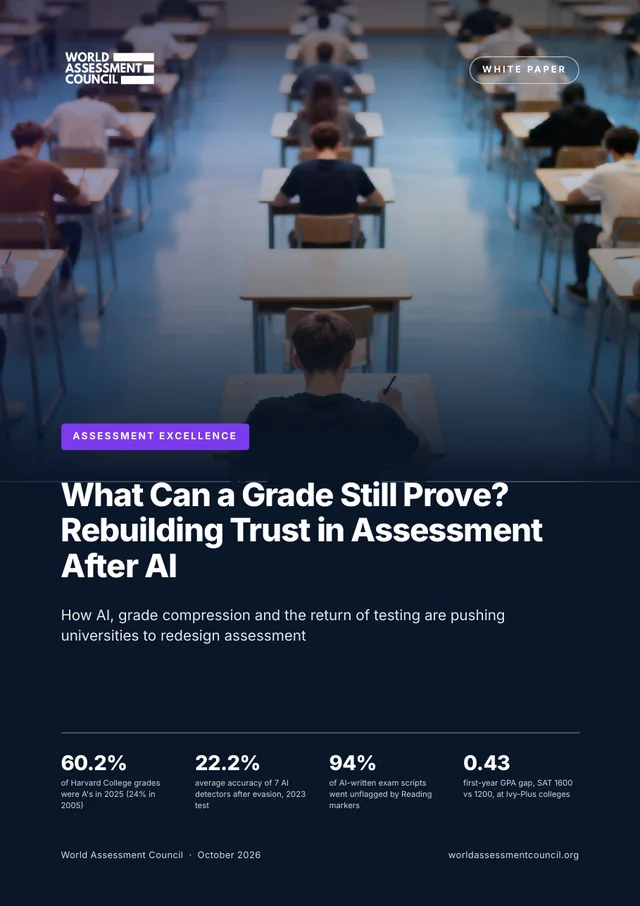
What Can a Grade Still Prove? Rebuilding Trust in Assessment After AI

The Rise of the Regional Hub: Asia, the Gulf and the New Student Flows
From the same centre
See what the Centre for Assessment Excellence works on, with its analysis and the news in its field.