
Universities Navigate AI Revolution as Faculty Voice Concerns Over Assessment Integrity and Digital Divide
Global survey reveals 83% of educators worry about students’ critical thinking abilities while institutions race to establish clear AI governance frameworks
Universities across America and Europe are grappling with unprecedented challenges as artificial intelligence fundamentally reshapes higher education, with new research revealing a widening gap between institutional AI adoption and faculty preparedness that threatens to undermine traditional assessment methods.
The stark reality emerged from comprehensive studies released this month, showing that while 86% of faculty members anticipate using AI in their teaching future, only 17% consider themselves at advanced or expert levels in AI literacy. This disconnect has sparked urgent calls for institutional reform as universities struggle to balance innovation with academic integrity.
Faculty Concerns Mount Over Student Assessment
The Digital Education Council (DEC) Global AI Faculty Survey, involving 1,681 faculty members at 52 higher education institutions from 28 countries, revealed widespread concerns about students’ ability to critically evaluate AI-generated outputs, with 83% of faculty members expressing concern.
“The data are clear: faculty want to use AI, but the lack of training and institutional clarity is holding them back,” says Alessandro Di Lullo, CEO of the Digital Education Council and Academic Fellow in AI Governance at The University of Hong Kong. “Both institutions and individuals must act now to embrace AI literacy, or risk leaving educators and students unprepared for the future.”
The survey findings paint a picture of an education sector in transition, with over half of faculty (54%) believing current student evaluation methods are no longer adequate in the age of AI, with 13% calling for an urgent, complete revamp. This assessment crisis has forced universities to reconsider fundamental pedagogical approaches that have remained largely unchanged for decades.
Perhaps most concerning is the institutional support gap. Only 4% of faculty are fully aware of their institutional AI guidelines and feel they are fully comprehensive. Just 6% fully agree that their institutions have provided sufficient resources to train faculty’s AI literacy.
UNESCO Calls for Human-Centered AI Integration
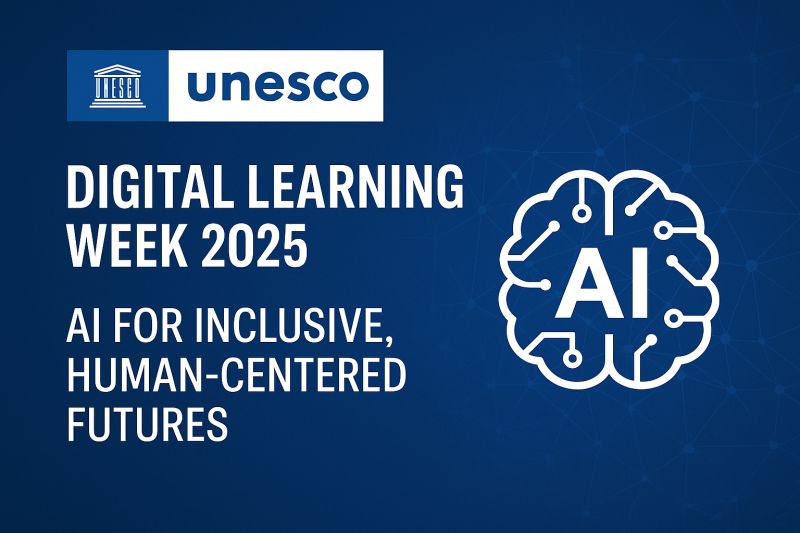
The urgency of these challenges took center stage at UNESCO’s Digital Learning Week 2025, where global education leaders gathered to address what many consider the most significant disruption to higher education in generations. The dialogue concluded with a shared vision and a strong commitment: the integration of AI in education must be human-centred, equitable, safe, and ethical.
Ministers from around the world identified five critical priorities during the closed-door sessions:
- Confronting the emerging “AI divide”
- Ensuring safety and ethics to protect all learners
- Protecting the irreplaceable role of teachers
- Promoting AI that reflects local contexts, languages & cultures
- Advancing global solidarity and shared standards
UNESCO Assistant Director-General for Education Stefania Giannini affirmed in her closing remarks that “together we have committed to shaping a global commons for dialogue and action”, a space to collectively ensure AI serves as “a tool for equity, dignity and the flourishing of all people and our planet”.
The organization’s recent survey of its global network revealed telling statistics about AI adoption in higher education. While nine out of ten respondents already use AI tools in their professional work, only half felt confident in their understanding of AI’s technological foundations and pedagogical applications. Only about 34% reported positive experiences with AI-assisted assessments, highlighting the need for further guidance and professional development.
American Universities Embrace Transformation Despite Challenges
In the United States, higher education institutions are taking increasingly proactive approaches to AI integration, though not without significant hurdles. Industry experts predict that 2025 will be a pivotal year for establishing the regulatory and institutional frameworks necessary for safe AI deployment in academic settings.
“In 2025, I predict we’ll see a rise in state and federal legislation around the use of artificial intelligence in classrooms. But even with the best intentions, legislators may end up inadvertently putting up barriers for tools that are actually helping students learn,” warns Kelsey Behringer, CEO of Packback, a leading educational technology company.
This concern reflects broader tensions within American higher education as institutions balance innovation with oversight. “AI ed tech is going to get a lot messier before it gets better. There are going to be raging debates about whether it is worth it and if we’re getting any real value from it,” predicts Betheny Gross, research director at WGU Labs.
However, some educators see this turbulence as a necessary prelude to transformative change. Jenny Maxwell, head of education at Grammarly, believes “In 2025, we’ll see institutions shift from AI as an adversary to an ally, unlocking the biggest transformation for pedagogy and student learning.”
Maxwell outlines four essential steps for successful institutional AI adoption:
- Establish clear and consistent policies guiding both educators and students
- Develop comprehensive AI literacy programs for all stakeholders
- Utilize AI detection tools within broader academic integrity frameworks
- Foster open conversations between faculty and students about responsible AI use
European Leadership in Digital Accessibility
European universities are approaching AI integration with particular attention to accessibility and inclusion, driven in part by new regulatory requirements. The European Accessibility Act, which came into effect in June 2025, mandates that all digital learning products entering the EU market must meet strict accessibility standards and obtain CE certification.
Any product entering the EU market post-June 2025 must earn CE certification. Even U.S. and UK-based providers serving EU users need to comply. This requirement has pushed European institutions to lead in developing inclusive digital learning environments that serve diverse student populations.
The European Association of Distance Teaching Universities (EADTU) has been at the forefront of this movement, with upcoming conferences focusing on new modes of teaching and learning, open education, and quality in blended and online education. The organization’s 2025 Envisioning report, recently published, explores emerging trends in digital higher education across the continent.
European universities are also pioneering innovative assessment methods. The AUREA (AUtomatic REcognition Assessment) project, funded by the Erasmus+ programme, kicked off at the beginning of 2025 to develop automated recognition systems that could revolutionize how student achievements are evaluated and transferred between institutions.
The Assessment Revolution: Beyond Traditional Testing
The crisis in student assessment has sparked innovation across both continents, with universities experimenting with new evaluation methods that account for AI assistance while maintaining academic integrity. Research published in Frontiers in Education explores emerging frameworks like FACT (Formative Assessment with Collaborative Technology) that attempt to balance AI-assisted learning with traditional evaluation methods.
Faculty with higher AI proficiency perceive greater transformative change that AI will bring to their role as instructors and to student assessment, but see AI as less of a threat to their jobs than faculty with lower AI proficiency. This finding suggests that AI literacy training could be key to successful institutional transformation.
The survey data reveals a notable geographic divide in faculty attitudes. Faculty in the USA and Canada are more likely to see AI as a challenge compared to their international counterparts, suggesting that cultural and regulatory contexts significantly influence AI adoption strategies.
Reflecting these concerns, 81% of faculty ranked facilitating students’ critical thinking and learning as the most essential skill for educators in the digital age. This emphasis on critical thinking represents a fundamental shift from traditional content delivery models toward more sophisticated pedagogical approaches.
Digital Divide Threatens Equitable Access
Perhaps the most pressing concern emerging from recent research is the widening digital divide that threatens to create new forms of educational inequality. UNESCO’s latest publication highlights the emergence of an AI divide, as one in three people worldwide still is offline.
This divide manifests not only in access to technology but also in institutional capacity to provide adequate AI education and support. The Digital Education Council’s research shows that 80% of faculty feel there is a lack of clarity on how AI can be applied in teaching within their institutions.
Daniel Bielik, President of the Digital Education Council, emphasizes the urgency of addressing these gaps: “AI is a rapidly-evolving area for the world of higher education and we see information, such as our surveys, as opportunities to understand exactly where to put good processes. As AI technologies improve and become ubiquitous, institutions will need to undertake considerable reform.”
Institutional Responses and Strategic Planning
Universities are responding to these challenges with increased investment in digital infrastructure and faculty development. Since 2024, UNESCO has supported 58 countries in designing or improving digital and AI competency frameworks, curricula, and quality-assured training for educators and policy-makers.
The organization’s AI competency frameworks for teachers and students, along with the UNESCO Recommendation on the Ethics of Artificial Intelligence, have created a roadmap for an ethical, equitable, and human-centered and human-rights based future for AI in education.
American institutions are particularly focused on operational efficiency and decision-making applications of AI. Industry experts predict that “Artificial Intelligence will encapsulate many other emerging technologies over the past 10 years. This will be driven by the trillions of dollars invested by AI start-ups and tech giants. This will result in more affordable and intuitive breakthroughs for faculty and students.”
The transformation is expected to accelerate significantly in the coming months. “The faculty’s AI adoption rate will accelerate the demand for ed tech vendors to adjust their deliverables and pricing models. The ed tech companies that master the changing campus environments and bring operations and academics together will be the runaway winners.”
Looking Ahead: Collaboration and Standards
As universities navigate this digital transformation, the emphasis is increasingly on collaborative approaches and shared standards. The success of initiatives like Digital Universities US 2025, hosted in collaboration with leading institutions, demonstrates the value of cross-institutional knowledge sharing.
The event series, designed to bring together the higher education community and innovators to discuss the opportunities and challenges associated with a digital-first future, has become a crucial forum for developing best practices and policy recommendations.
European institutions are similarly emphasizing collaboration through initiatives like the European Year of Digital Citizenship Education 2025, which member states of the Council of Europe considered as one of their priorities during recent ministerial meetings.
The path forward requires unprecedented coordination between institutions, governments, and technology providers. The survey identified three key enablers for successful AI integration that are becoming standard across leading universities: comprehensive policy frameworks, extensive faculty training programs, and robust student support systems.
Global Implications and Future Outlook
The challenges facing American and European universities reflect broader global trends in higher education digitalization. 64% of global faculty believe that AI will bring significant transformative change to the roles of instructors, signaling that the current disruption is just the beginning of a more fundamental transformation.
The sentiment remains divided among educators, with 65% viewing AI as an opportunity and 35% perceiving it as a challenge. However, when considering AI’s broader impact on higher education, while 57% view it positively, 13% perceive it negatively, and 30% remain neutral, indicating uncertainty among faculty.
This uncertainty underscores the critical importance of the policy decisions being made today. As UNESCO’s Digital Learning Week emphasized, “AI is creating disruptions in education. This raises human and policy dilemmas and forces us to reflect on the directions we should take. The future of education will be shaped by the policy choices that we make about education investment, about pedagogy, about governance and about the ethical principles we uphold.”
The coming months will be crucial in determining whether universities can successfully navigate this transformation while maintaining their core educational mission. The institutions that succeed will likely be those that prioritize human-centered approaches to AI integration while investing heavily in faculty development and student support systems.
As the academic year progresses, the higher education community will be watching closely to see which institutions emerge as leaders in this new digital landscape and what lessons can be learned from their experiences. The stakes could not be higher, as the decisions made today will shape the future of higher education for generations to come.
Resources and References
- Digital Education Council Global AI Faculty Survey 2025 – https://www.digitaleducationcouncil.com/post/what-faculty-want-key-results-from-the-global-ai-faculty-survey-2025
- UNESCO Digital Learning Week 2025 – https://www.unesco.org/en/articles/unesco-convenes-global-leaders-digital-learning-week-2025-shape-inclusive-human-centred-futures-ai
- Campus Technology – “3 Areas Where AI Will Impact Higher Ed Most in 2025” – https://campustechnology.com/articles/2025/01/15/3-areas-where-ai-will-impact-higher-ed-in-2025.aspx
- UNESCO AI and Education Publications – https://www.unesco.org/en/articles/ai-and-future-education-disruptions-dilemmas-and-directions
- Digital Universities US 2025 Conference – https://www.timeshighered-events.com/digital-universities-us-2025
- European Association of Distance Teaching Universities (EADTU) – https://eadtu.eu/
- European Accessibility Act 2025 Compliance Guide – https://creativtechnologies.com/2025/07/02/is-your-elearning-ready-for-european-accessibility-act-2025-how-to-stay-compliant-inclusive/
- UNESCO Recommendation on the Ethics of Artificial Intelligence – https://www.unesco.org/en/artificial-intelligence/recommendation-ethics
- AUREA Project (Erasmus+ Programme) – https://www.eua.eu/our-work/topics/learning-teaching.html
- Digital Learning Institute Future of Learning Report – https://www.digitallearninginstitute.com/blog/the-future-of-learning:-what-to-expect-in-digital-learning-in-2025