
Skills Gap Report 2025
The skills gap is less a shortage of talent than a failure to measure, recognize and build it
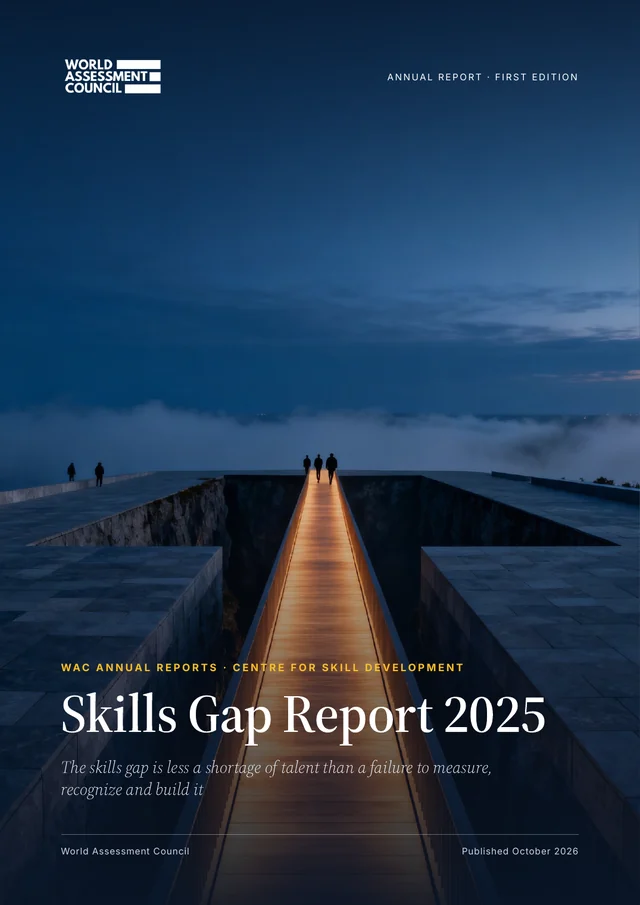
The skills gap is real but narrower, more specific and more self-inflicted than headlines suggest. Drawing on about 270 studies, official statistics and surveys, this first WAC Skills Gap Report finds genuine shortages in care, trades, energy and AI, weak and stagnant foundational skills, and widespread under-use of talent. Much of the gap lies in how employers measure, recognize and build skills. The report introduces the WAC Skills Readiness Framework and ten signals to watch in 2026-2027.
The report in numbers
Key findings
- Seventy-two percent of employers in 41 countries report difficulty finding talent in 2026, down from a 77 percent peak in 2023 but roughly double the 2014 level.
- Official data show shortages easing: UK skill-shortage vacancies fell from 36 percent of all vacancies in 2022 to 27 percent in 2024, and US job openings fell to 7.1 million by August 2026.
- Under-use of skills rivals under-supply: 26 percent of workers in the OECD Survey of Adult Skills say they are over-skilled for their job, against 10 percent under-skilled.
- Foundations are weak and not improving: 26 percent of adults in OECD countries score at Level 1 or below in literacy and 29 percent in adaptive problem solving, and only Finland and Denmark significantly improved adult literacy over the decade.
- Employment of 22- to 25-year-olds in AI-exposed US occupations is 19 percent below where it would have been had it kept pace with less-exposed peers, while economy-wide effects remain small.
- Only 39 percent of workers using AI at work had received AI training from their employer, while 66 percent of leaders said they would not hire someone without AI skills.
The report has 12 key findings in all, 12 chapters of evidence, an original framework and recommendations for five audiences.
Inside the book
 Chapter 1
What the skills gap is, and how it is measured
One phrase covers shortages, proficiency gaps and mismatch; each is measured differently, and the method often decides how large the gap appears.
 Chapter 2
The global picture: what employers, workers and tests show
Employer complaints doubled in a decade and are easing only slightly, while tests show adult basic skills stagnating in rich countries and lagging from childhood in poorer ones.
 Chapter 3
AI and the reshaping of skill demand
Generative AI lifts novices, squeezes entry-level hiring in exposed jobs and pays a premium for AI skills, while employer reskilling lags its rhetoric.
 Chapter 4
The skills in shortest supply
Real shortages cluster in AI, cybersecurity, trades and health care, while the human and foundational skills beneath them are both prized and thinly spread.
 Chapter 5
The skills gap around the world: a regional analysis
From graduate surpluses in Asia and North Africa to demographic shortages in Europe and East Asia, the gap takes different shapes and needs different responses.
 Chapter 6
Sector by sector: where the gaps bite
Shortages in care, trades, energy and teaching are driven by demography, pay and slow pipelines, while technology and finance face changing entry-level work.
 Chapter 7
Skills-based hiring: promise and practice
Employers and governments have stripped degree requirements from postings, but hiring has barely moved; valid assessment, not edited job ads, is what changes outcomes.
 Chapter 8
What works: evidence on closing skills gaps
Randomized trials favor sector-focused training tied to employers; broad vouchers, generic training and self-paced online courses have weaker records.
 Chapter 9
Who gets to upskill: workers, learners and inequality
Adult learning flows to those who already have the most skills, in the largest firms, and in their prime working years; money alone has not reversed that.
 Chapter 10
What the gap costs
Trillion-dollar estimates of the skills gap are model scenarios, not measured losses; the firm and worker evidence shows real but smaller and more specific costs.
 Chapter 11
The WAC Skills Readiness Framework
A practical tool, synthesized from this report's evidence, for finding where a skills gap really lies and what universities, employers and governments should do next.
 Chapter 12
Outlook 2026-2027: what to watch
Ten signals will show whether the skills gap is narrowing, shifting or widening, and what evidence would change the picture.
A chart from the report
Firms that dropped degree requirements: did hiring change?
Share of firms studied
One recommendation for each audience
For universities
Publish graduate outcomes by program, measured as employment in jobs that use the degree, and tie program growth to that evidence rather than to enrollment demand; 52 percent of US graduates start underemployed and most who start that way stay there.
For employers
Before declaring a shortage, check pay against the market, audit applicant-tracking filters and compare training spend with hiring cost; in cybersecurity, budget rather than candidate supply was the most cited cause of shortages.
For edtech and training providers
Build for completion and verified outcomes, not enrollment: completion in HarvardX and MITx courses fell to 3.13 percent, against 46 percent among learners who paid for verified certificates.
For policymakers
Report skills shortages alongside vacancy duration, wages and training data, and fund repeated direct tests of adult skills, since employer surveys alone can overstate and misdiagnose gaps.
For learners and workers
Choose programs by field and graduate outcomes, not prestige alone: five years after graduation, underemployment is 23 percent for health graduates but 57 percent for general business fields.
This report is desk research: a synthesis of about 270 published studies, official statistics, employer and workforce surveys and management-journal analyses. WAC ran no survey or trial for it. Every chapter was checked against its sources by an independent fact checker before publication. The photographs are AI-generated illustrations. Send a correction · Research Standards
More annual reports
AI in Learning Report 2026
AI is improving the work students hand in faster than what they learn; design, not access, decides the outcome
Read about the reportFrom the same centre
See what the Centre for Skill Development works on: its white papers, Spotlight analysis and the news in its field.