AI in Learning Report 2026
AI is improving the work students hand in faster than what they learn; design, not access, decides the outcome
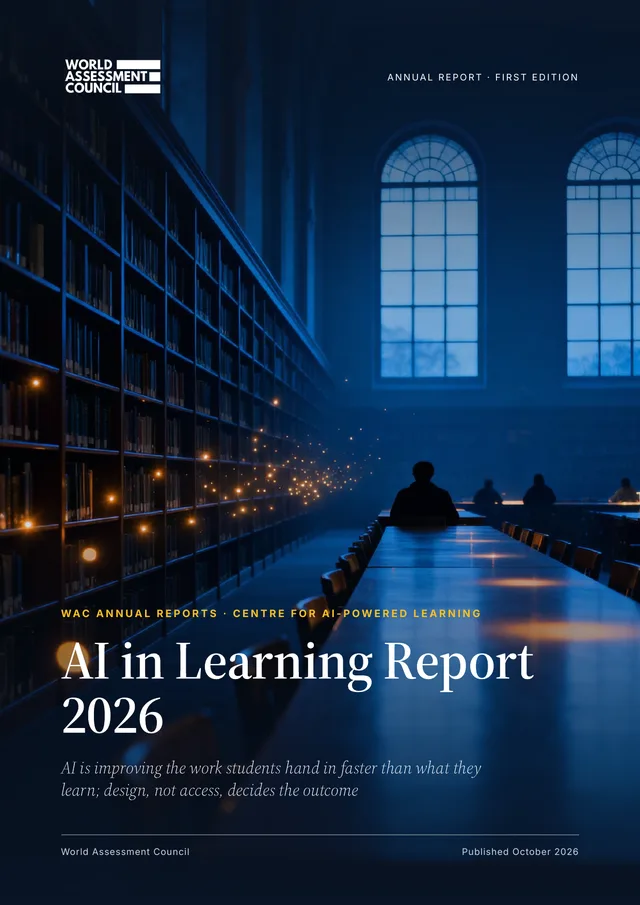
AI use in education is now close to universal; its benefit for learning is not. Drawing on about 270 distinct sources, from studies and official reports to surveys and news, this second WAC Annual Report finds that open access to AI often improves the work students hand in while weakening what they learn, whereas tutors designed to withhold answers, used with teachers, can produce large gains. Rigorous evidence is thin, institutions trail their users and assessment bears the costs. The report introduces the WAC AI Learning Readiness Framework and ten signals to watch.
The report in numbers
Key findings
- Use is near universal: 95 percent of UK undergraduates used AI in HEPI's 2026 survey, up from 66 percent in 2024, and US students using AI for homework rose from 48 to 62 percent in seven months of 2025.
- In a PNAS field experiment, unguarded GPT-4 raised high-school practice scores by 48 percent but cut later unaided exam scores by 17 percent; a guardrailed tutor removed the harm without adding a gain.
- In a 2026 randomized trial (working paper) with 2,379 University of Maryland undergraduates, access to a course-integrated AI tutor lowered final grades by 0.37 standard deviations, and only about 15 percent of students used it.
- In a working paper following 26,811 Chinese secondary students, AI adoption raised homework scores 18 percent but cut monthly exam scores 20 percent, with entrance-exam losses of 18 to 24 percent over about two years.
- Structured, purpose-built AI tutoring can work: gains of 0.73 to 1.3 standard deviations in a Harvard physics trial and 0.31 standard deviations in six weeks in Nigeria (World Bank working paper), at about 48 dollars per pupil.
- The evidence base is thin: only 20 of more than 800 K-12 AI papers offered strong causal evidence, and a widely cited positive meta-analysis (g = 0.867) was retracted in April 2026.
The report has 12 key findings in all, 12 chapters of evidence, an original framework and recommendations for five audiences.
Inside the book
 Chapter 1
AI in learning in 2026: what changed and how to read the numbers
AI use is now easy to count and learning is still hard to measure; this chapter defines the field and the traps in its most-cited numbers.
 Chapter 2
Adoption in 2026: students, teachers and institutions
Student use is near-universal and teacher use is climbing, but policies, training and licenses trail behavior, and the gaps by place, gender and income persist.
 Chapter 3
Does AI help people learn? The evidence to date
Purpose-built AI tutors can produce large gains, but in 2026 the evidence turned sharply: open access to chatbots often raises homework scores while lowering real learning.
 Chapter 4
Teachers and faculty: time, training and a changing job
Trials confirm AI saves teachers time, though far less than they report, while training, guidance and safeguards on marking and professional skill trail well behind use.
 Chapter 5
AI in education around the world in 2026: a regional analysis
Governments are racing to put AI in classrooms, but the 2026 record shows reversals, thin evidence and a widening gap between policy ambition and school reality.
 Chapter 6
Universities: strategy, licenses and the new campus
Campuses have bought AI faster than they have planned for it; the real changes are coming in assessment and the entry-level job market.
 Chapter 7
Schools: from bans to AI literacy
Schools moved from blocking ChatGPT to teaching AI in three years, but guidance, teacher support and evidence trail student use, especially in poorer schools.
 Chapter 8
Risks and trade-offs: integrity, thinking, equity and wellbeing
Unstructured AI use can lift grades while cutting learning, detectors misjudge the wrong students, and companion chatbots have become a child-safety issue regulators are only starting to address.
 Chapter 9
The AI edtech market: money, products and evidence
Capital, users and pricing power have shifted to AI labs and platforms; answer businesses collapsed, and evidence of learning impact still trails adoption.
 Chapter 10
Governing AI in education: law, guidance and standards
Binding law, federal promotion and soft guidance now coexist; 2026 brought delays and reversals, and institutions still trail their own users.
 Chapter 11
The WAC AI Learning Readiness Framework
A practical tool, synthesized from this report's evidence, for judging whether an institution or system is ready to use AI in ways that improve learning.
 Chapter 12
Outlook 2027: ten signals to watch
Ten signals will show whether AI is improving learning or only the work students hand in, and what evidence would change that reading.
A chart from the report
Proven AI cheating rises as proven plagiarism falls in UK universities
Cases per 1,000 students
One recommendation for each audience
For universities
Tie every AI license to a named learning or service problem, with activation and outcome metrics agreed before renewal; California State University renewed for 39 million dollars with about 47 percent of eligible users activated.
For school systems and school leaders
Train teachers before giving students AI tools, as Singapore and Estonia did; Singapore reached 75 percent teacher use with 76 percent of teachers trained, while Korea's rollout, launched before teachers were ready, was reversed within a school year.
For teachers and faculty
Design tasks in which AI explains rather than produces; students who used AI for explanations kept their gains a week later, while gains from AI-written work vanished once the tool was removed.
For edtech companies
Ship tutoring as the default and publish how often students use it; the median student in the Khanmigo trial messaged the tutor in only 17 percent of practice sessions with a mistake.
For policymakers
Fund independent trials with delayed, unaided outcomes before scaling AI tools; England's trial of Aila measured a 49-minute weekly saving against three to four hours reported earlier.
This report is desk research: a synthesis of about 270 published studies, official reports, surveys of students, teachers and institutions, and journal analyses. WAC ran no survey or trial for it. Every chapter was checked against its sources by an independent fact checker before publication. Edorer Education and Lecture Studio, described in Chapter 9, are related to WAC; they are described from their own public pages. The photographs are AI-generated illustrations. Send a correction
More annual reports

Skills Gap Report 2025
The skills gap is less a shortage of talent than a failure to measure, recognize and build it
Read about the reportFrom the same centre
See what the Centre for AI-Powered Learning works on: its white papers, Spotlight analysis and the news in its field.